
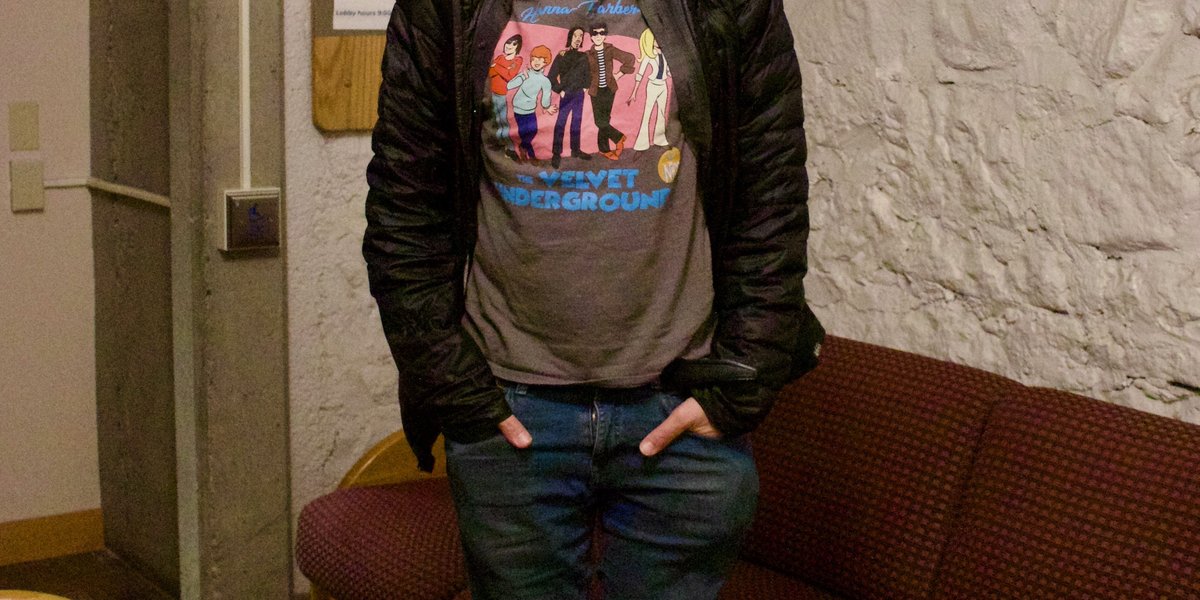
On February 28th, 2026, just before the band Jeffrey Lewis and The Voltage,took the stage in Old Main Theater, Molly, Wavelength’s resident writer, sat down with the self-proclaimed “anti-folk” indie-folk music artist and comic extraordinaire frontman Jeffrey Lewis to ask some questions about music, art, multimedia, and everything in between, including Sunday mornings.
Molly Shoffner:
My name is Molly, I work for a student publication here at Western called Wavelength, and we're a multimedia publication, so we wanted to talk to you about multimedia because you are a multimedia artist, which is so awesome. So, my first question is, what does it mean for you to make multimedia art?
Jeffrey Lewis:
Well, in some ways, I think the world is geared towards specialization because everything is so competitive that, if you're trying to do five different things, it's probably really hard to get ahead in one of those things if you're competing against somebody who is exclusively doing that one thing without being distracted by the other things. So, I think just, by nature, it's probably a mistake to get involved with too many kinds of media.
I think, my, both my, the music that I make and the comic books that I make are, probably, you know, not as far advanced as they might be if I just had picked one or the other. But, they both appeal to me so much that it's hard for me to imagine not having both in my life. I just, I love comic books so much, and I love music so much. I get a lot of enjoyment from the creative challenges of each one, and I like the weird career that I've chiseled out for myself by combining them. But, yeah, it's, I really often think that if I had just stuck with drawing and making comics without all of this distraction of touring and making songs and music, I'd certainly be a number of levels further up from where I am.
Shoffner:
So, my next question is, off of that, how do you incorporate your other forms of art and media into your music?
Lewis:
Well, I was making comics and drawing like, since I was a little kid, so that just was always part of my life. And, when I started making songs and doing performances, which didn't happen until I was in my twenties, the comics and drawing were just so interwoven with what I do that it just was natural for me to incorporate them in every way that I could think of, which started off with me making little comic books that would advertise my concerts, and I would just kind of hand out my comics—these little one or four page comics that were, would have a weird little story, and then it would kind of also say, “and Jeffrey Lewis is performing on Wednesday the 25th, at 8pm,” you know, and the concerts were great for selling my comics. So, I realized that if I sort of had my comics that—at that point I was just photocopying and, you know, folding and stapling myself—if I had my comics available at the concerts, that was a really great way to reach people with the comic books. That was so much more direct than trying to get things in consignment at bookstores or comic book stores.
And, then, I was also really trying to be part of the New York City music scene and making myself available to anybody that wanted album art, poster art, whatever, I drew a lot of stuff for local zines and magazines and, without charging any money I was just always making myself available. Like, I just was the guy in the music scene who was into drawing and anybody knew that if they wanted an album cover or a poster, like, I was a good option for them to go to, and I would really try to put my best foot forward and make stuff that I thought people would, you know, gravitate towards. So I was sort of trying to get, you know, a leg up in that way. And then, the real kind of weird mish-mash that I do is the illustrated songs where I started at open mics and at my little shows.
When I was starting out in New York, I would, like, perform singing a song while flipping through a large pad of paper that had drawings that would accompany it, and I didn't realize until years later that this was something that was common at a certain time in Japan and is called Kamishibai—if I'm pronouncing that right, which I might not be—but apparently that was an art form that was popular in Japan after WWII, when a lot of things were sort of in an almost pre-industrialized, like a lot of people didn't have televisions, a lot of things were destroyed. The economy was in tough shape after the war, and people would travel from town to town providing entertainment by sort of singing or telling stories and showing drawings that they had made with the stories and, kids and people would gather to watch these stories and then, at the end, they would sell, maybe candy or something.
And, I was amazed when I learned about this, because I felt like it was very similar to what I do, I kind of go from city to city, and I present these songs and stories that have accompanying illustrations, and then I'm like, you know, “at the merchandise table, we have our comic books, shirts, you know, records.” So, it's, it's, I feel as though there's this Japanese tradition that I was unwillingly, unwittingly, a part of, and it seems natural to me. I think, you know, art and stories and songs, they are very low technology, and they are very compelling. I think there's something just naturally entertaining about these things.
Shoffner:
Have you considered selling candy after your shows from that?
Lewis:
No, but I did, actually, at one point when I was in my early years in the late 90s/early 2000s, when I was still making all these little comics to advertise my gigs, I was always trying to come up with quirky ideas to catch people's attention, and one of the things that I did, I did it maybe two or three times, was I bought a whole bunch of like, bubble gum from shops, and I rewrapped the gum in my own wrappers that would be little, mini comic books. Actually, I did it with peppermints one time also, but the original idea was like the Bazooka gum that used to come with a little comic strip in it. I thought it'd be funny if, like, you could get a piece of, sort of, Bazooka gum but it would have this, like, super long comic strip that just told this, like, epic story.
So, I made, made these, like, really long strip comics that, like, would wrap around and around and around the gum and then, like, on the packaging outside, it just said, “and Jeffrey Lewis is playing a concert on Thursday the 12th at, you know, 10pm, blah, blah, blah.” So, it was something I could like, hand out. I would have like a little jar of it and I would hand it out to people at the open mic. But, this was all before touring started for me, and at that point these things just became way too impractical, it was, took so much effort to, like, put all that together, do the photocopying, cut the
things up, wrap all the—you know, maybe at most I might make like seventy of these pieces of Jeffrey Lewis gum or candy that had comics inside advertising my shows, and that took a lot of labor just to do. So, you know, it might reach a couple dozen people just in my little New York City music scene but, as things kind of started to include touring and other places it just became too impractical.
Shoffner:
I love that story. I—yeah, how do you see your multimedia art and its various forms interacting or in juxtaposition? Because I know you, like, use your art as, like, covers for your albums and you make it into stickers, but is there any other forms where you see it?
Lewis:
I think, for anybody who just enjoys making stuff and the challenge and the rewards and tortures of the artistic, creative life, songs and drawings and comic books all are part of the same zone of easy access that don't require very elaborate materials. They don't require elaborate technology, they just require the creative drive to want to make something, and in a certain way, it almost speaks to a kind of impatience to see the final product. And, that was a big reason why discovering Daniel Johnston's recordings was, like, my biggest influence in making music because it was so direct, the way that the Daniel Johnston recordings from the 80s seemed as though he would just make up a song and then hit record on a tape player or whatever kind of recording device and just play it, and then that was the album and you just didn't have any of these middle process steps of needing extra gear or anything else and then just making a drawing for the, the album cover.
And, as opposed to, say, theatre or film making or, you know, many other forms of art that I can think of that might take more of a crew, more equipment, more funding, there was something very hands on about making comics myself and making songs and recordings in the way that Daniel Johnston had inspired me to just make it very simple and direct, that it was like, you could do that in one day. It was like, “oh, hit record, play the songs, do some artwork for the cover, make, you know, make some copies on cassette or CD-R”—when I, when I got to the point of having like a CD burner and it was like, literally I would have them ready for that night's show or the next day. It was just so direct.
And, nowadays there's even a kind of return to that in the way that I could draw a little comic book and put it on Instagram and somebody could see it that day, anywhere, and I can make a recording and put it on my Bandcamp page, and it's, it's up there the same evening and, be like, it'd be like, “hey everybody, there's a new album. It's on my Bandcamp page.” And the technology has allowed sort of a return to that very immediate, direct way of making something and presenting it to somebody. So that's, well, I don't know—I mean, the technology's always changing, but whatever the technology is at the time, whether it's cassettes or, streaming, there's an appeal to just making stuff. So, I think people that like to make stuff always have, you know, some way of figuring out how to do it.
Shoffner:
There seems to be a lot of accessibility, like, put at the forefront of your, your art and your process, and I'm assuming that's intentional not only for yourself, but for the people who are listening and reading.
Lewis:
Yeah, there's, in some ways it's almost a roundabout way to get around the insecurity of presenting stuff, because if it's quite obvious that you didn't work on it for years, then you have a kind of built in excuse for all of the rough edges of it. Where, I think, if you get in the headspace where you're going to work on something to a level of perfection, it's a lot scarier and you keep delaying the release of the thing you're like, “oh, it's not perfect yet. I can still fix this,” or, “oh no, it's not really even good. I hate this, it's not.” And, I feel like a lot of people, in the creative fields I've noticed people get really caught up in that kind of perfectionism.
That just means they spend, you know, years working on an album that they probably could have made in a week or something, or—which is not to say that there isn't a place for making something as good as you can possibly make it. I think that's really great too, but in my case, I think, I, I was really helped by the idea that I didn't have to be as intimidated if I was making stuff that kind of made it obvious that it wasn't trying to be perfect and that was, again, just a lesson I got from Daniel Johnston that really just changed my life, I had never thought about things that way before I discovered Daniel's stuff, and I just, kind of, owe my whole adult life to his example.
And, I've tried making things in a lot of different ways. I mean, sometimes I'll make a comic book and I'll say, “okay, this time I'm going to do this as elaborately and, you know, as good as I can possibly make it. I'm going to just spend a huge amount of time on this and really show off what my skill level is currently at.” And, same for making a record, sometimes I'll be like, “okay, I'm going to just put, you know, as much time into this as I want. I'm not going to settle for anything less than, you know, I'll do as many guitar takes until I get this right or I'll, you know, really try to make this as good as I can make it.” And, I don't know, I feel like those, the ones that I've spent the most time on in some ways are the ones that people respond to less.
It's hard to know with the comic books because I don't get a lot of immediate feedback on the comics. They just go out in the world, and I'm not sure, I'm not there when somebody's actually reading them. But, when it comes to music, I can look at the stream counts and it's quite ironic that the recordings that cost the least to make and were the quickest to record have so many more streams than the recordings that were the most expensive to make and took the longest to record. That seems true when I look at my twenty years of putting music out. I don't know if that's true for other artists, but it's kind of ironic when I look at my own stuff.
Shoffner:
That's really interesting. Yeah, I think for me it's, like, something really raw and human to hear it like that, and that's what I appreciate about your, raw, more raw pieces. To move on though, what sort of art, content, and multimedia have you been consuming recently and, like, just really immersing yourself in?
Lewis:
Well, I listen to music pretty much all the time. It's pretty rare that, you know, any opportunity to listen to music and have something on whether I'm home or I'm traveling or whatever the case is. If I'm home, I'll just be putting on one record after another, after another all day long. Or, I have a five disc CD changer that an old roommate of mine left behind with me many years ago and, thankfully it still works, and I just, I love loading it up, just, putting five CDs in and closing the drawer and then just listening to one album after another for hours, and then loading it up again with five other ones.
And, I've got tons of music on my laptop, and then my girlfriend has Spotify, so we're always, like, listening to her Discover Weekly and, other stuff. And we're, you know, I'm just constantly listening to stuff.
I still go to record stores and look for weird stuff, and I'm still like, “oh, what is this? Maybe I should take a chance on that. I know I have too much stuff at home already, but this looks really interesting, and it's only a few bucks,” you know.
So, and then, as far as comic books and other stuff that I consume, the artists that I really like are not very prolific these days. You know, if there's ever anything that I see by Julie Doucet or Chester Brown or Dan Clowes, or the Hernandez brothers or, you know, a pretty small handful of creators whose comics I love, Ben Snakepit—I love reading those comics—Gabrielle Bell, Karla Paloma. But really, these people don't put stuff out very regularly so if I'm in a comic store and I see something from one of them that I haven't seen and I'll be like, “oh, wow, there's like, you know, there's a new Gabrielle Bell thing,” like, I'll definitely snap it up and be super excited to take it home and read it. But many months or even years might go by when these people aren't putting something out. And, you know, once in a while I'll check out some other comic stuff.
Then, you know, I try to read books. I read a lot of music books. I'm always kind of addicted to reading books about different bands. And, even if bands that I'm like, not even a huge fan of, I just find it interesting to see the career arcs and all the stuff that they went through. So I'll usually if, you know, maybe if I'm traveling and I'm in a used bookstore or something and I'm like, “oh, here's, you know, the life of, Madonna or whatever it is,” I'll, whether it's somebody I'm super familiar with or not, a lot of times I like reading those things.
Shoffner:
Awesome. How does the constant music in your life and these comics that you're, you know, engaged with, inspire your own comics and musical output?
Lewis:
Tremendously, I mean, I'm just super, always inspired by stuff. And a lot of times I think, as, whatever it is you're into making, whether you're a writer or a singer or a filmmaker, I think you can't help but get excited and be inspired when you're when you're seeing stuff, and then it even makes you often want to make something like that. I might hear some—it could be anything, whether it's some 60s garage rock or some, you know, 90s rap or some something more modern, or—a lot of times it just starts the gears turning in your head and it's like, “oh, I want to make something like that.” Like, and similarly for, you know, if I see a particularly moving or striking film or read something, yeah, it does really give you an artistic excitement and sort of makes you want to get back to work on making stuff.
Shoffner:
And then to move beyond that, what are your, like, non-artistic or non-musical inspirations for your art?
Lewis:
Well, let's see, I guess, uh, well, it's odd being as grown up as I am and feeling like the whole social context in which I started making my stuff has really shifted and, you know, improved enormously. If I think back on what things were like for me as a kid, as a teenager, and even into my twenties and
even into my thirties, I feel like—especially in my younger years, if I'm thinking about teenage years and in my twenties—it was an era that was lonely at a level that it's hard for me to even conceive of now. And, you know, in some of my earlier song lyrics where I talk about, like, just, you know, being alone for months at a time or the just the sense of enormous alienation and isolation and also being totally broke, like just having zero money and not knowing, you know, just the total uncertainty of what's going to happen to my life.
That has shifted in so many positive ways that now I am, you know, I have friends, I'm in a relationship, I have an apartment that I'm happy with, I have money in the bank. I have, you know, people come to the gigs, there's like—I can go play in Bellingham and there's people that buy tickets to come see me that know the songs. I've developed quite a lot of skill at making comic books that I kind of feel like now I know how to make a comic, I can sit down and make a comic if I want to. So, a lot of things have just changed so much for the better that the inspirations that used to fuel me when I was starting out were just, you know, a level of such vast desperation in my youth that that has really shifted. I feel like, now, the stuff I've been making in recent years isn't coming from an inspiration of, like, that kind of desperation, and now I kind of just appreciate the skill or the impact of what I have sort of developed being able to create, and I really just appreciate being able to do anything at all. I'm like, “wow, I can't believe I can make a song and I can make a comic.”
And I have, you know, to spend so much time doing this stuff that I feel like I've gotten better at it, and I just feel proud of my—and I would like to get better at all these things. You know, I want to be able to make better songs, better albums, better comic books, better drawings. That challenge never goes away, so that is a constant inspiration, whatever else has shifted is just the idea of like, the next blank page still remains a challenge. Like, “what are you going to do with this blank page? How are you possibly going to turn this into a decent song or a decent drawing?” It's like there's still so much agony of, like, doing something that doesn't excite me. And I'm like, “agh, I suck, I'm just—” you know, that is sort of constant, that never goes away, and just the constant insecurity about, you know, you make one thing after another after another, that, like, seems not that good, and it's just like, “agh, I'm all washed up now. I'll never make something good again.”
But I've been feeling that way for my whole life. I mean, you just you just keep pushing through that. I mean, I remember feeling like I was over the hill when I was, like, twelve years old, but you just keep on going and eventually get to some other good thing that you've made.
Shoffner:
As a current twenty-three-year-old that was, like, really nice to hear, honestly. That's my two cents there. Um, to move on, is there any, like, form of art or multimedia, in any sense, that you haven't yet incorporated into your practice but you've considered, you know, to at least explore, even for yourself, not necessarily to put [out] publicly?
Lewis:
I guess the first thing that comes to mind would be that, you know, I've been making my comics, all the comic books that, like—if you look at the stuff that I have on the merchandise table at this show, the comics are all in black and white, and that always just seemed like financial necessity from starting out making photocopies that I could sell, and, nowadays, I would be financially able to print a comic in full color. It would be a lot more expensive to do, but it's something that I've thought
about doing just to see how that would come out. It would take a lot of time to do the coloring and there's something that I like about black and white comics anyway, but that's an area where I have had the thought of, like, “it could be interesting to, like, do a comic in full color sometime.” I wonder what that—you know, that would be a different thing for me.
And then, you know, the illustrated songs that I do that, at this point, I'm using a projector to project them, to project the artwork, larger because once the audiences get bigger than like 40 people in a room it's harder for them to see if I'm just standing on a chair flipping through a large pad of paper so I had to transition to using the projector when I play bigger shows. But using the projector could allow me to do more with the art projections, you know, it's possible that I could incorporate some kind of animation or, you know, using the projector is something that I've kind of underperformed at. Like, you know, when I was just starting out and maybe I would just be standing on a milk crate flipping through these pads of paper that I would be drawing with crayons, I think that strikes the audience as, “wow, this person is going above and beyond what was possible in that medium.” Like, maybe if I was at an open mic or I might just be in the street, I was like, you know, in parks or it was something that was like, wow, I was really, like, expanding what was possible in that context. But now that I have this digital projector I don't feel as though I'm expanding what's possible to do with a digital projector. So, if anything, I'm doing less than what it could be doing, so I've thought about ways that maybe I can approach that differently—it doesn't really appeal to me, I like keeping things more simple but, yeah, if I, if I have to think of some ways that I might expand.
Oh, and then of course there's also the idea of like actually learning how to play guitar and sing. I think that would expand things. And, honestly, I've had the fantasy that like, what if I just, like, book myself into some kind of like singing boot camp for a week or two? I'd probably learn, like—harmonizing is a really big thing that is not in my toolkit, and I think that would add so much to what I could do with my bandmates on stage if I really knew how to sing harmony vocals. It's like, wow, there's four of us on stage, we could be doing some kind of, you know, Beatles, Beach Boys, harmony at such a rich sound to have multiple voices. And it never crosses my mind because I just don't think of things in that way, like, you sing a third up from me, and then, you know, that person will sing the minor fourth above that, and you can create these blocks of tone. It's a shame too, that's an instrument that we're carrying around with us in our throats and just not utilizing them.
And then I've never learned how to play any guitar scales. I think if I actually—you know, once again, this fantasy that somehow I could do it in a condensed period of time if I went to some kind of… you know, gave myself a month of intensive study, obviously I wouldn't become a shredder in in a month but I could at least learn some better rudiments because I can't really play guitar solos. If I do a solo, there's sort of like two or three things I know I can do: I put my finger here and I know it sounds good if I also put my finger there, but that's, you know, about the extent of it. And, considering that I've been playing guitar for, you know, 20+ years, it's like, that's a little ridiculous, I should know how to do more. So that would be a way to expand.
Shoffner:
That's interesting, definitely. Um, I consider that, like, your artwork blends both genre and obviously media—is this a conscious thing that you do in your work?
Lewis:
Well, that's a good thing that you point out there, because I think that that really compels me and interests me, this, this blending where things are sort of unexpected and they step outside of their own framework. And a lot of things have inspired me that are like that, like, you know, when I first, when I was maybe twelve, or thirteen, or something, and I first saw Evil Dead 2, and I always think of that as such a pivotal thing for me. It's, like, such a favorite movie of mine because it was just not what I expected at all. I was really scared to watch it because I thought it was going to be a horror movie, but then all these other weird things happen and you're just like, “what?” It's like, is this a comedy? Is this a superhero movie? Is this a—that just went in so many directions that I wasn't anticipating. And comic books like that also, like when Dan Clowes was doing Eightball comics in the 90s and into the early 2000s, just every issue was like, “wait, what? Like, I thought this was going this way, but now he's doing this, and now—” you know, that, that idea of constantly surprising yourself and surprising the audience.
And so, I do get inspired by the idea of surprising people and surprising myself because I get very delighted when I come up with an idea, it's one of my favorite feelings. I'll just start laughing out loud to myself like a maniac because I'm like, “wait, I can do that? Like, that would just be so crazy if I actually did that. Like, no, I can't do that. All right, I'm gonna try to do that,” and just get some kind of, you know, idea that you get excited about.
Shoffner:
So, would you consider your, blending of genre, like, conscious or not? And then I have a follow up question.
Lewis:
Conscious in the sense that I'm aware of it, but not conscious in the sense that, it's not really a conscious choice. It's just what gets me excited. It's like, often that, you know, is where I'll feel like I get excited about an idea. I mean, I guess I don't sit down to think of, like, let me make a genre crossover thing, but if I'm making something and some weird left-field idea comes to me, then I really just start getting excited about like, “oh, yeah, I think I'm gonna put that in, I'm trying to incorporate that” or something. So, definitely, I'm aware that that sort of thing appeals to me.
Shoffner:
Well, that kind of answered my follow up questions. My last couple questions are just, kind of more fun ones. I've seen that you've opened for a lot of people and a lot of bands, what was your favorite artist to open for and why?
Lewis:
Well, I guess, the European tour that I did opening for Stephen Malkmus and the Jicks was a pretty big deal for me and my brother Jack, who was playing bass with me at the time. It was just really exciting to be able to play with these indie-rock legends, and they were so, they were so awesome on that tour. And, um, well, I guess playing with a lot of people that were inspirations to me initially is amazing to be able to cross paths with them. I got to open for Daniel Johnston a few times in different circumstances over the years and The Television Personalities was a band that was a big influence that I got to play a gig with, and, uh, I mean, Roky Erickson I got to open for and a lot of things that I sort of can't believe actually happened—The Fall, they're one of my favorite bands, I got to open up for The Fall once.
So, there still remain a couple of, you know, if I could ever possibly open for Yo La Tengo or Jonathan Richman. I feel like those are like the two ideal goals, but both of those acts rarely even have opening bands, I feel like they do a lot of gigs where they don't have an opener. But, considering how big an influence both of them are on me, those are sort of the two biggest ones that I would kind of be like, “all right, that is like every dream complete.” Of course, you know, there's like unrealistic ones. That would be, like, opening up for, you know, Neil Young or Bob Dylan, or something like that. Patti Smith or something. But, you know, that seems like a whole other level. But in terms of just like indie-rock and songwriters and stuff, that doesn't seem out of the question that something like that might happen someday, but so far, it still hasn't.
Shoffner:
Awesome. Well, I certainly hope it does. If you open for Yo La Tengo, I would—I would be there. My second to last question is just what does your ideal Sunday morning look like?
Lewis:
Well, let's see—I've been in the habit of jogging for thirty minutes, and so I would just get up and go do a jog, and then, well—I keep saying my girlfriend, but we did just get married recently, so I have to say wife. I got to get used to saying that. So, yeah, then I would have a nice breakfast and coffee with my wife, who I love hanging out with. And then we would just both do art and listen to records. I try to do that as much as possible. When I get home from tour I hope that she and I get to spend more time just drinking coffee and listening to music and working on art. I love that she'll just be at one table, I'll be at my desk and, we'll both just be drawing and working on stuff and listening to stuff and thinking about what to do for dinner. Yeah, that's how I like to spend time.
Shoffner:
Your ideal Sunday morning sounds like my ideal Sunday morning. And then my final question is just what are your current obsessions?
Lewis:
Well, I don't know if I have ones that haven't been the same old obsessions for a long time, which is like 60s psychedelic music, which, just, since teenage years, I've just always been trying to seek weird 60s music. And I guess I'm obsessed with reading about music, and I've just been reading all these books. Anything about The Fall, I'm just, like, an obsessive fan of The Fall. So, I just read, like, two books about The Fall in a row. And, well, on this tour, we've been somewhat obsessed with finding acai bowl places for breakfast in the morning, so this has been a bit of an acai bowl tour. So, maybe there's a place we can find in Bellingham in the morning before we get on the road. “Acai bowl near me,” that's like our morning routine, just type that into the phones, and then we just kind of compare them and be like, “how was this one compared to the one that we got in LA or the one that we got in Nashville?” You know, so that's kind of fun to do a tour like that.
Shoffner:
Yeah, I love that kind of thing. So, that's all my questions. Thank you so much for being interviewed and talking with me.
Lewis:
Well, I yak and yak, so good luck transcribing and boiling it down into, like, a nine hundred page novel. But yeah, thanks for yeah, thanks for doing that.
Thank you to Jeffrey Lewis for being such an enthusiastic interviewee and providing responses that match that sentiment.
