
What It Means to Make a Temporary Space an Intentional Home
Growing up, my home was always split between two places—my mom’s house and my dad’s house. Over time, as I moved with either one of my parents, I became familiar with the idea that home wasn’t so much created by the space I was rooted in (since I didn’t feel particularly rooted in any space) but instead by my own intention to make a space a home. That meant that, for me, by the time I moved out of my parents’ houses, I was almost comfortable with the idea that I had to make a home for myself—while I felt (and still feel) incredibly strong ties to the people who helped to create a home for me where I’m from, I didn’t feel many ties to the rooms, houses, or spaces themselves.
One of the most important things about college is getting the chance to learn what home means to you and what actions you take to make that space a home, especially knowing that you most likely won’t be living in that same space in a couple years at most. The house that I live in now, I have lived in since the summer after my freshman year at Western. I’ve grown into an entirely new person in this house, but at the end of this spring, once I have graduated, I’ll be moving out to create a new home in Bellingham with my partner. As I consider graduating and moving out of this house, I consider how I have made this space, which I share with my partner, three of my closest friends, and three cats, into a home.
Just as it’s important to learn what home means to you and what actions you take to make that space a home in college, it’s also important to expand your own conception of home by learning how others create home in their lives. Every year, one member of the Wavelength staff visits other staff members in their spaces to see how they have created a home for themselves there, and this year, it was my task to take on.
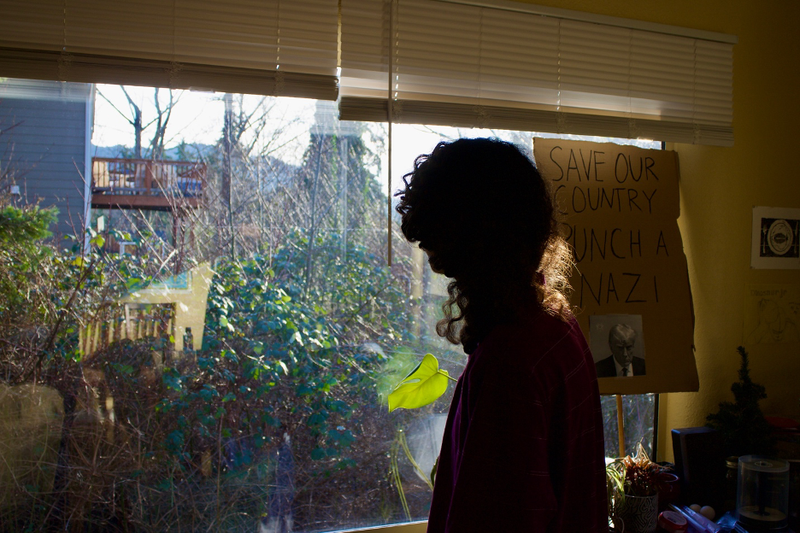
Brent stands in front of a window in the house he rents, looking out at overgrown foliage and the deck of the house next door.
Brent lives in a large house with many roommates, and when I walked up to the house on the day that I took these photos, I found a single Nerf dart sitting in the yard. When Brent greeted me at the door, I commented on it, and he said he was surprised there wasn’t more, as they often have Nerf battles out there. Walking into the house, there were two Beyblade arenas sitting in the center of the living room rug. When I pointed these out, Brent said that was him and their roommates were up to the night before as he put them away.
Visiting Brent’s home, I would say that these first glimpses can sum up a lot of what I learned about Brent’s approach to creating a home: play and community, which makes sense for what I have come to know about Brent since we started working together.
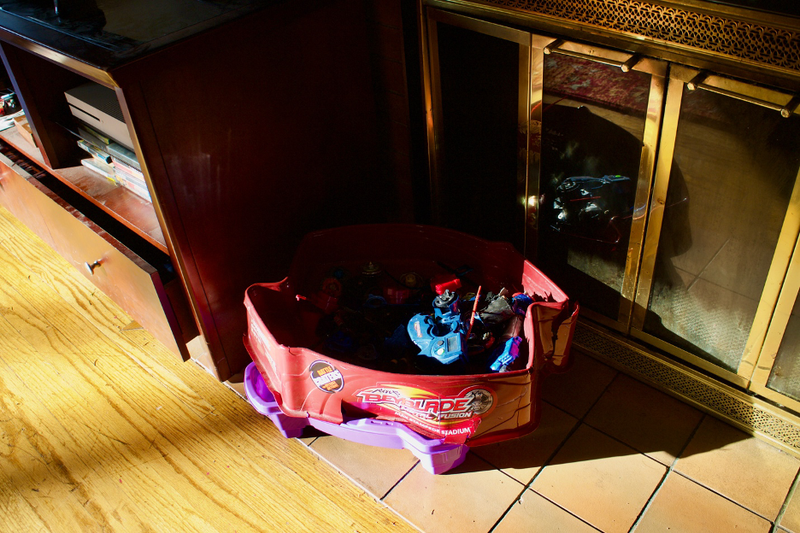
A Beyblade arena, full of Beyblades, sits in front of the fireplace in Brent’s house.
Going into Brent’s room, he insisted that “it’s pretty lacklusterly decorated,” but I would have to disagree. The definition of lackluster is “lacking in vitality, force, or conviction; uninspired or uninspiring,” and Brent’s room certainly did not lack vitality, or conviction, and I found it to be inspiring. While there might not be much in the room, it’s still full of life, as the space itself and the objects within it reflect how Brent lives.
“I honestly don’t spend much time in here either,” Brent said. “I pretty much spend all my time in the living room and just come down here to sleep.”
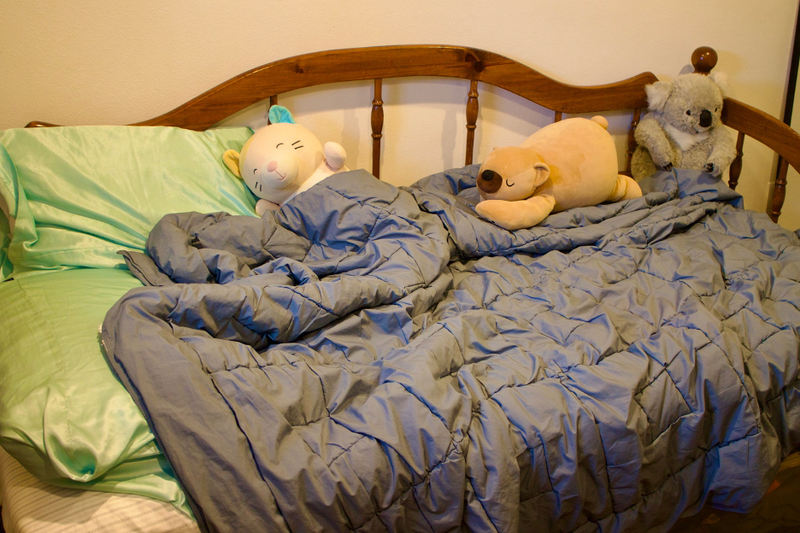
Brent’s bed, a wooden daybed style with two green pillows, a gray comforter, and three stuffed animals.
The home that Brent has created exists outside of their things, but, still, those things reflect the home that they have created. He has filled his room with bits and pieces of his life over time: the monkeys hanging above his bed are from his time working at the Pacific Science Center in Seattle, a decal with a mouse saying “Think Big” was in the Wavelength office before Brent saved it from recycling and hung it on his wall, and the rodent bones that sit in a jar on his windowsill are from one of his roommates.
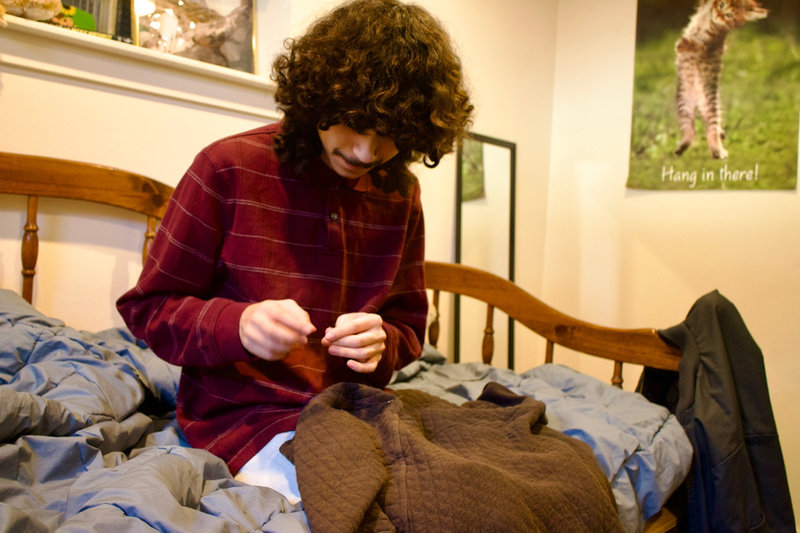
Brent sits on their bed, hand mending a sweater. Behind her hangs a poster with a kitten on it that reads “Hang in There!”
Outside of their individual things, Brent’s space is filled with signs of the actions taken to create their provisional home. Though he has “had boxes since [he] first moved in that [he] just [doesn’t] know what to do with,” he has a familiarity and comfortability with the space that tells me he sees this as a form of home.
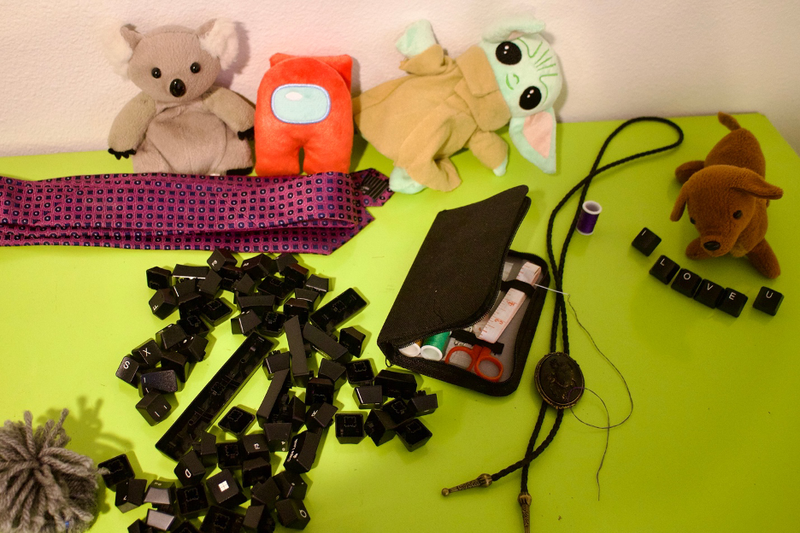
The top of Brent’s neon green dresser is scattered with a collection of items, including a sewing kit, a bolo tie, four small stuffed animals, and a pile of keyboard keys.
I couldn’t help but ask about the keyboard keys, piled on top of his dresser. For something so intriguing, he gave me a very matter-of-fact answer that explains a lot looking back on it, essentially saying, why not do it if it makes him happy?
“Oh, I just bought a keyboard and then I took the keys off. I made this little doggy: ‘I love you.’ It’s very uplifting. A lot of uplifting things.”
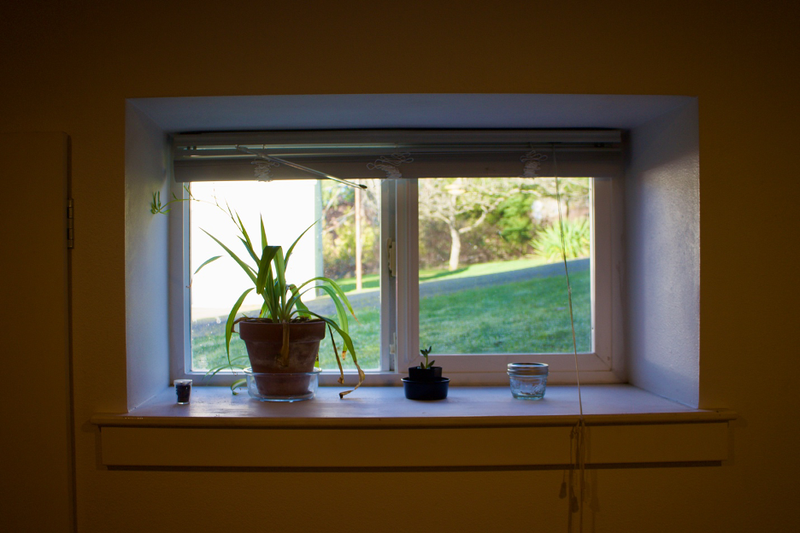
A window in Brent’s room, overlooking the yard outside. On the windowsill sits two plants and a jar that holds rodent bones.
It seems as if Brent could make a home for himself no matter where he is. He might just be the embodiment of that cliché, “home is where the heart is,” because wherever Brent’s heart is, he finds a home outside of the physical. To Brent, it’s their community that matters most; creating home comes from having the people who mean something to them.
“I’m not specifically attached to this place. I just kind of sleep here. I really enjoy that it’s just a place where all of my friends are, so it's like we all just come together and hang out. I go to bed and then I wake up, I come upstairs and then, like, all my friends are here. It’s like, ‘yay, guys, we're all just hanging out.’ And then we hang out all day until it gets late, and then I go into my room, and I just go straight to bed.”
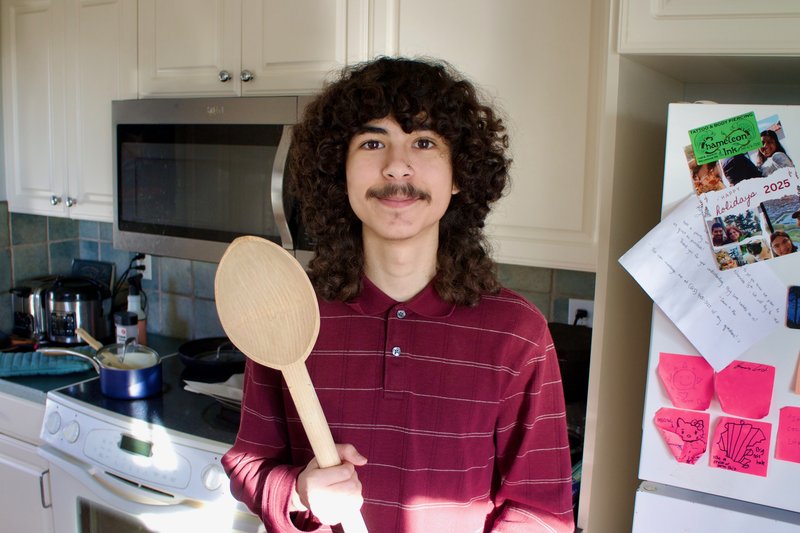
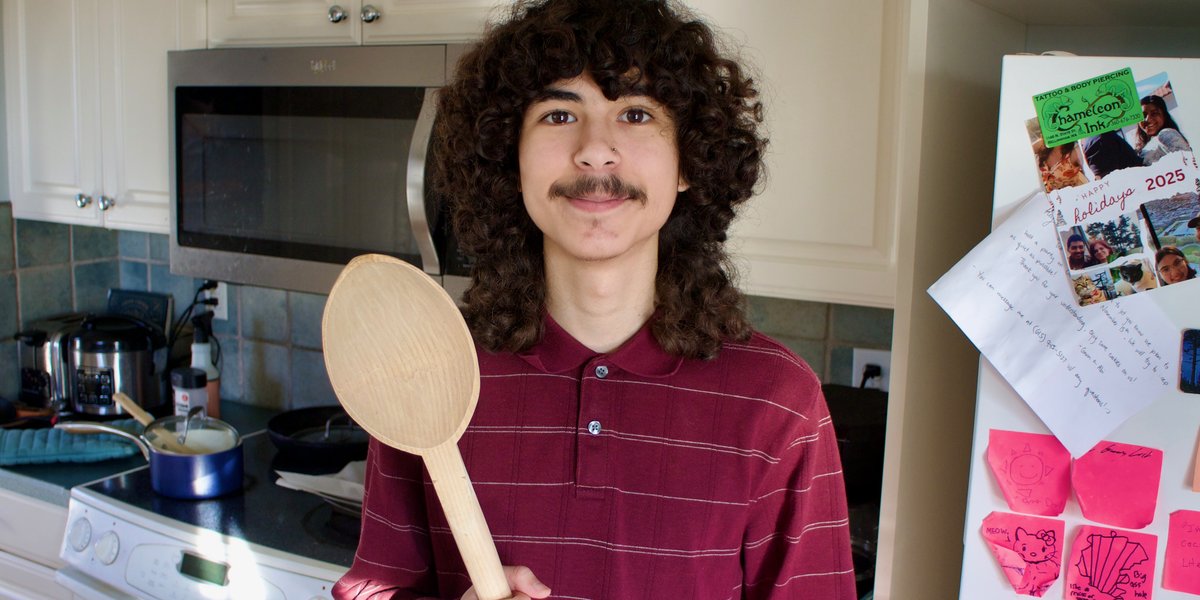
Brent stands in their kitchen, holding a giant wooden spoon that his grandfather made.
Though Brent doesn’t have an attachment to the space, he still has items that remind him of the people who may feel like home to him, but aren’t around, such as the wooden spoon his grandfather carved. “This is my grandfather's spoon. He made it. … Zamboni. It's for, like, stews. He would make big pots over fires, and they would make their stew.”
[I’m not quite sure why Brent said “Zamboni” here, but I really appreciated it, so I’m keeping it in the middle of the quote.]
These memories feel like home for Brent and offer insight to how he might create even more of a sense of home for himself in the future. “I want to make my own stew with this spoon, over a fire. If I find a pot big enough for this spoon, I would gladly make a stew,” he said.
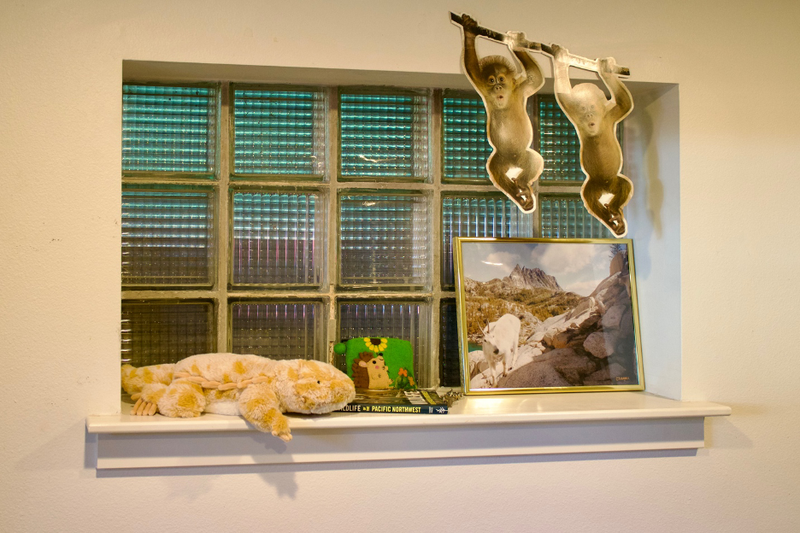
A glass brick window in Brent’s room, on the windowsill sits a collection of items, including a stuffed animal and a framed photo of a mountain goat. Attached to the wall above the window is a decal of two monkeys hanging from a branch, which Brent said he got when he worked at the Pacific Science Center in Seattle.
Upstairs, Brent explained how he appreciates how his roommates create their own sense of home, “Sometimes I sit right here. I like to just look over here when I’m bored. I know people just leave random things, and so, like, it's like a fun little collection.”
Community is a marker of how the house has become a home for not only Brent, but also their roommates. A curtain hangs between the living room and kitchen, covered in signatures. “Everyone signs it. It was at [my roommate’s] dorm last year, and then everybody who came in signed it.”
Even I got to sign the curtain, and it felt like the perfect way to be welcomed into their home.

A brown stuffed dog sits on the top of Brent’s neon green dresser with “I LOVE U” spelled out in keyboard keys in front of it.
Though Brent said he’s desensitized to the space, he still finds aspects to cherish, like the view from the window in his dining room.
“I stand over here and watch the neighbors because the neighbors, sometimes they go out on the porch and they never look over here, so I try to get their attention every time I see them, but they never look in this direction. I do spend a lot of time right here in this room, just looking out the window. This morning, there was like an awesome light beam.”
While Brent doesn’t seem to identify much with his room, Lily has perfectly curated her room to be a reflection of herself and her individual sense of home.
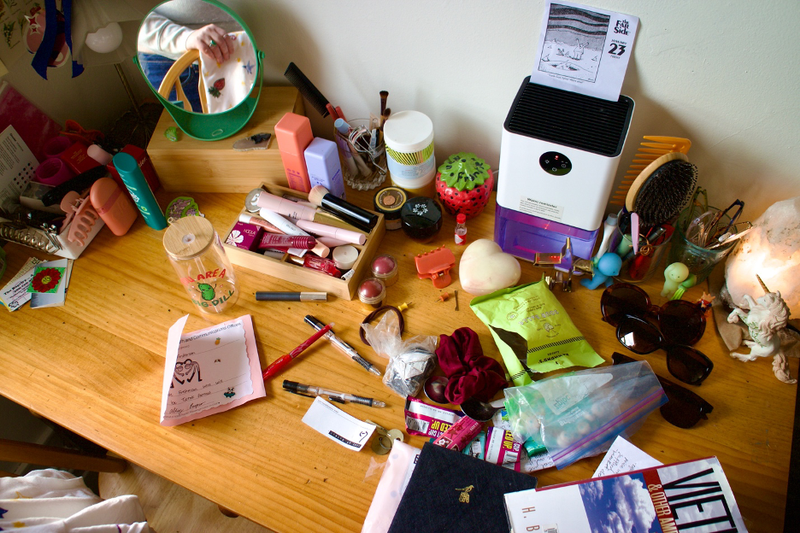
The top of Lily’s desk, covered in a wide range of items including multiple pens, books, sunglasses, trinkets that hold meaning for Lily, her makeup, and an award she received from the former Wavelength director her freshman year. The small mirror that sits on her desk reflects Lily’s hand on the back of her desk chair.
Lily emphasizes her messy desk and connects it to a crucial facet of her concept of girlhood and her routine, saying, “Every girl has a messy desk. Every morning, I sit, and I get ready here, or I stand, and I get ready in the mirror, which feels like a cheat. It feels like I'm not supposed to do that. I didn't have the desk for the first two months we lived in this house. I think it really makes the room better.”
To Lily, her desk is the space she has to prepare herself and find a bit of confidence in her day. She said, “My desk is where I try to, like, make sure that I have the space to be ready and, like, feel good about myself.”
When I interviewed Lily, she told me to note the books about Vietnam that she had stacked on top of her desk—actually, she said “peep the Vietnam books.” Studying history at Western as the daughter of a high school history teacher, Lily and her sense of home wouldn’t be reflected in her room if there weren’t any signs of that significant theme in her life.
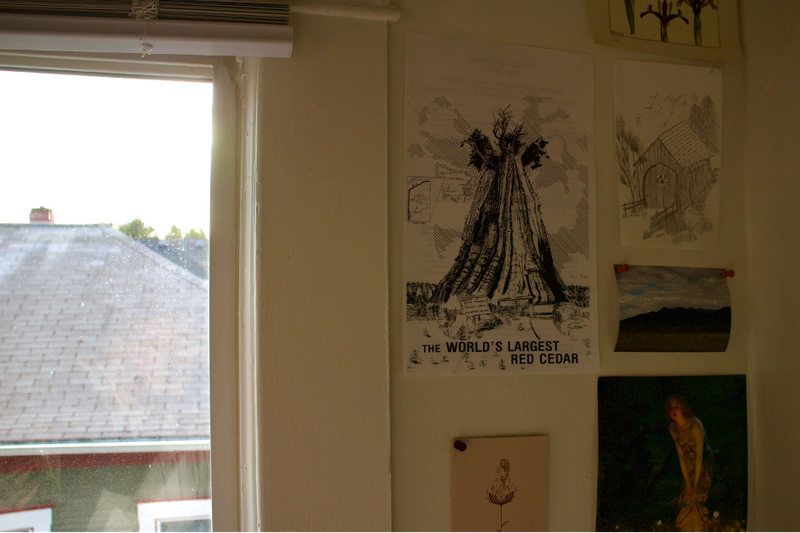
The wall next to Lily’s window, where she has hung multiple posters and images, including a poster that reads “THE WORLD’S LARGEST RED CEDAR,” a drawing that she did of her grandparents’ barn, and an image from the cover of a book her parents read her when she was a child.
Sentimentality creates a lot of Lily’s home in this space. Ephemera from different points throughout her life cover the walls and other surfaces. These things remind Lily of where she has found or created a sense of home in the past, as well as what brought her to create this home for herself, such as the cover of a Swedish children’s book her mom read her when she was a kid or a drawing she did of her grandparents’ barn.
“I'm not a good artist, but I did it,” she said. “And they don't own it anymore, so it feels sentimental now.”
This sentimentality has seeped into the drawers of Lily’s desk, where she keeps her junk journal and boxes of stickers and other ephemera she’s collected since her freshman year, but she wants to bring them out to where they can be appreciated, to continue building her sense of home.
“[It’s] just like weird stuff that I kept and never let go. […] My sticker collection, it's a lot, I feel guilt about using them. That's what I'm trying to work on as I go forward through my life—I’m burning that candle, using that perfume, putting the sticker on the bottle. Who cares?”
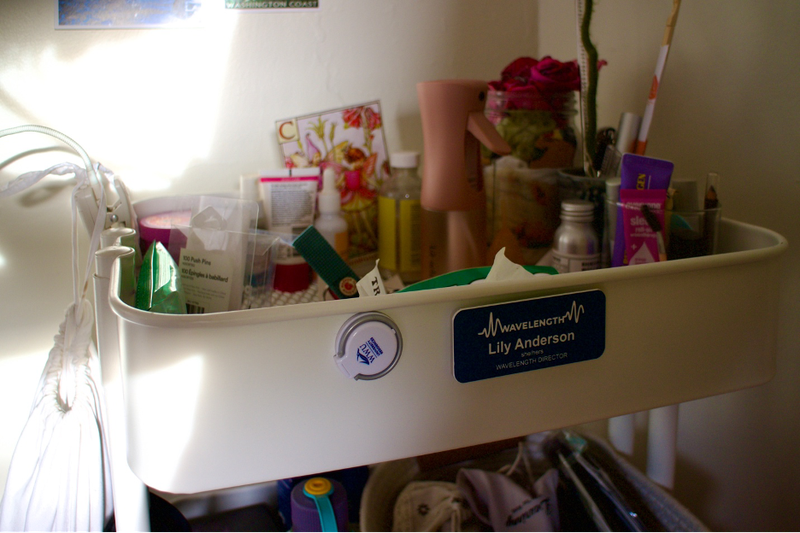
The top of Lily’s metal cart, with a random assortment of items inside it. On the front, Lily has attached her old Wavelength nametag.
Having spent most of her time at Western also working for Wavelength, this is the third iteration of home that Lily has shared. While a lot of it stays the same, each installment shows how Lily, and her sense of home, has changed over the course of that time.
“There's a lot of new stuff,” she said, “I've added things, but there's so many things that I had, like, three years ago when Kaeson did this the first time. But I think that's kind of the point, it shows what's constant in my life, and what means home to me.”
It’s the little things for Lily, like her windowsill of trinkets, each item tied to a person, moment, or theme of her life. “They all mean something different,” she said, “and they're all from different points in my life. Some of them may seem stupid to other people, but they matter to me in a way that I can't explain. That's kind of the point of a trinket. […] all of them together show the years of my life in an interesting way.”
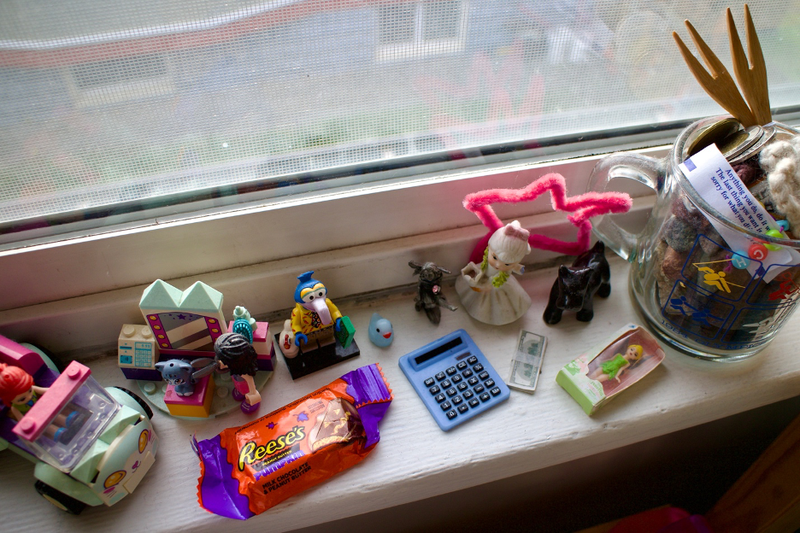
The windowsill in Lily’s room, where she has carefully curated an assortment of trinkets and items that have significance to her, including a Gonzo LEGO mini figure her dad gave her, a little silver fairy that she’s had in her room since she was a baby, and a mug that her grandma used to have, now filled with rocks she’s collected from Nebraska, Michigan, and Washington, all places that have meaning to her.
Even though the trinkets are so small, each one has a story attached to it that makes it feel like a piece of home to Lily because it’s a piece of her life. One of these stories is held in a cup on the windowsill, which she made in 8th grade. She’s filled the cup with rocks from a trip she took to Greece. “I collected them,” she said, “Everybody else was swimming in the ocean, and I was sitting there collecting rocks.”
Another story held on this windowsill is one of Lily rediscovering a piece of home. “The mug with the two little forks sticking out of it—that's filled with rocks I've collected from Nebraska, Michigan, Minnesota, and Washington. But the mug itself, my grandma had that mug when I was a kid and I loved to drink out of it—but you shouldn't drink out of it because it has lead in it—but it's from the Olympics, and it was a McDonald's Cup. I found it at Value Village in my freshman year and I had to have it.”
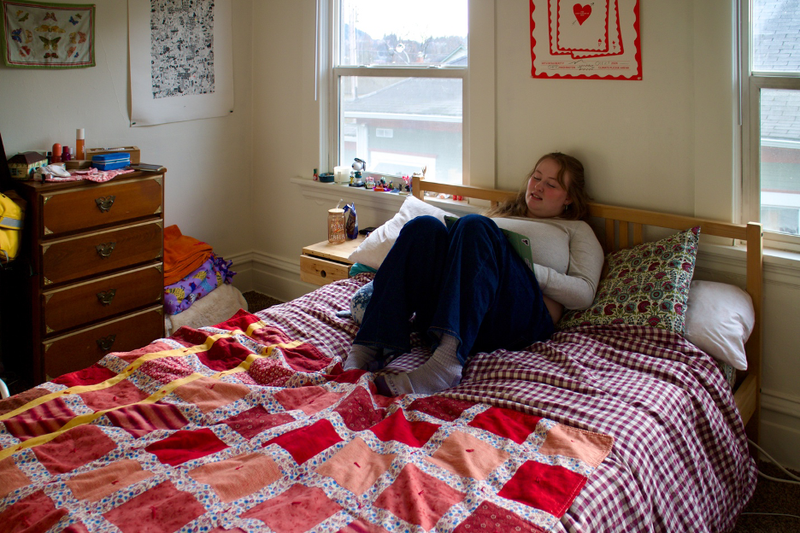
Lily sits on her bed, looking at her iPad. On her bed is a red quilt, a gingham comforter, and funky patterned pillows.
Outside of this space, Lily talks about her bed, a lot: how she spends time in her bed, how she’s going to spend time in her bed, how her bed feels, what she did to make her bed even better, how she wishes she could be in bed. Lily’s bed clearly means a lot to her and emphasizes her need for comfort in creating her home. Seeing it, I understand why she talks about it so much. Lily’s bed is a part of her routine in her home, so of course it is central to her sense of home.
She says that every day she comes home and sits in her bed. The comforter, which she bought a couple of years ago, felt like it was a very adult purchase. “My thought behind it was that your bed should be something that is special, like it should be comfortable. You should want to spend time in your bed. So, I was like, ‘I need to get a comforter and I need to get good pillow situation.’ I have a bunch more blankets in the corner there, and I usually pile them all on top because I like to feel, like, drowned.”
Central to her daily tasks, Lily’s bed seems to foster a lot of her sense of home, even if she doesn’t want to admit it. “I sit and I play [on my iPad], or watch TV, and then I do homework or Wavelength work. I spend a lot of time in my bed, more than I want to admit, because it's so good. It's unfortunate that I just made a really good bed. I spend time at my desk, but most of the time I'm in my bed.”
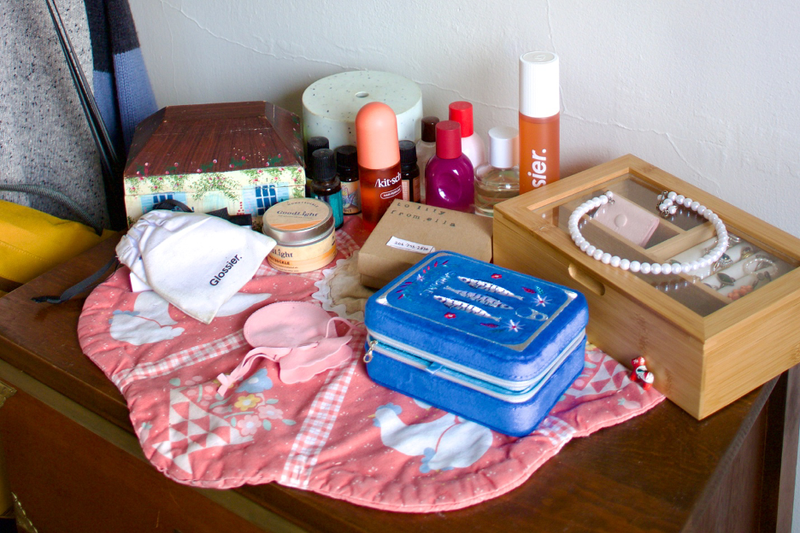
The top of Lily’s dresser, which holds pink quilted mat, a collection of her perfumes, a wooden jewelry box, a small wooden box painted to look like a cottage, and a case that looks like a can of sardines.
“As I've moved into houses over and over again, what I've gotten a lot more comfortable with is having my room be, like, a collection of things where there's comfort within it. Whereas like when I think I was in high school, it was about like aesthetics. I care less about aesthetics, […] I just want it to be me,” she said.
The manner in which Lily has placed each item on a surface or a wall in her room feels like an altar to her life, as if she’s romanticizing her home as an homage to every factor that has contributed to it. Though her intention was never aesthetics, the home that she’s created forms an aesthetic of its own, distinctive to her life and who she is, eternally Lily’s past, present, and future.
“This year, I've wanted to cover more spaces and, when I moved into the room, I was like, oh, there's so many like weird little spaces. Like, I mean, there, like that panel on the wall—And if you notice my little dog—Yeah. I was like, ‘oh, I should cover that with stuff,’ which now it feels weird, but it's not. It's just memories. I think, the thing about my room, is that it’s like it exists in this perpetual state of, like, forever, if that makes sense.”
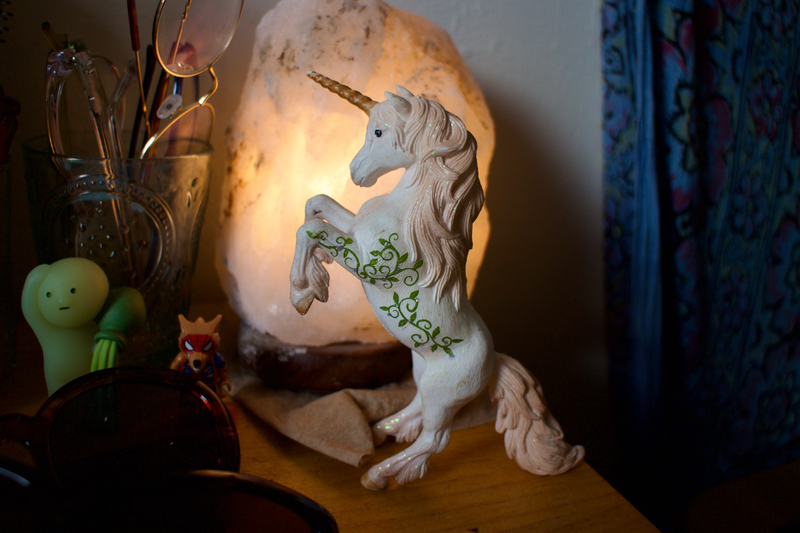
A closeup of items on Lily’s desk, including a unicorn figurine that she’s had since she was a child, a salt lamp, a glass that holds all of Lily’s glasses, and a Smiski figurine her mom got her for Christmas.
Lily sees a piece of herself in every piece that creates her sense of home, with each piece tying to an aspect of herself, down to remnants of her childhood, like the unicorn figurine that sits on her desk. She said, “I think this, this unicorn, perfectly encapsulates me as a person for some reason. I don't know why. It just feels… me.”
She identifies directly with the way she has chosen to create that sense of home. “A lot of stuff in my room is like fairy, flower themed, which I think, like, I don't know, I'm a girl named Lily. What am I supposed to do? Not have flower, fairy themed things? No. Be for real.”
Speaking to Lily about how she has created a home for herself as I took these photos, almost everything she pointed out brought up a story, either her own or one that has impacted her. Even the things that didn’t have a story to go along with them, Lily had still created them herself and intentionally chose their inclusion in her room to add to the larger story of home she is fostering.
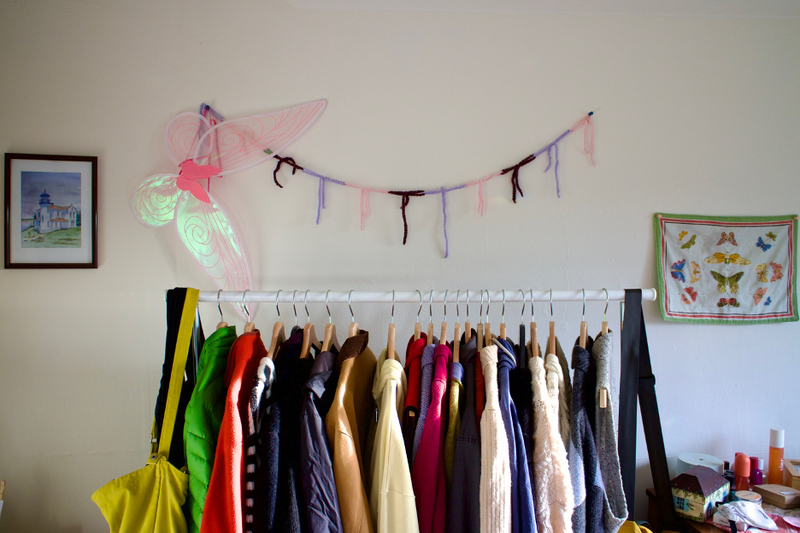
Lily’s clothing rack, filled with jackets and sweaters. Behind the rack, hanging on the wall, is a bow garland that Lily made, and a pair of pink fairy wings that Lily wore on Halloween last year. On one side of the rack hangs a framed image of a lighthouse, and on the other hangs a bandana with butterflies printed on it.
As time passed and Lily’s home and her sense of it evolved and accumulated to what it is today, she began to see home as a reflection of herself and the change that she has experienced over that time.
“I'm trying to emphasize that like, you keep going and then things just kind of follow you along and like suddenly you look around and you're like, wow, I had that on my wall when I was 18, and now I'm 23 and I still have it on my wall, and what does it mean to me now versus what it meant to me then.”
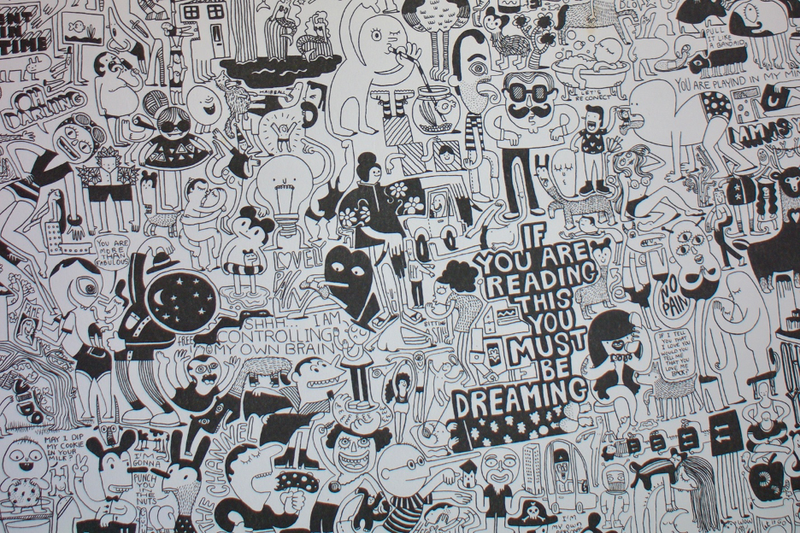
An up-close look at a poster in Lily’s room, which she’s had since she was in 8th grade, that features a funky assortment of characters drawn in black and white, with phrases interspersed. One of the phrases, visible here, reads “If you are reading this you must be dreaming.”
All that being said—and more—Lily’s creation of home is concentrated on the actions of her past experiences, her present routines, and the anticipation of how things may shift in the future. Her present routine acts of home include crafting, watching TV, and reading, trying to create this space of her own into one she wants to be in.
While I have known how to create a sense of home for myself since before I moved to college, it’s as if it’s come naturally to me in that time, like it’s something I don’t even have to think about anymore, and so asking myself how I do that takes reflection beyond what I consider when I am creating myself a home. Sure, I am always trying to make my space into one I want to be in as much as Lily is, but beneath that there are intentional actions, consciously or not, to foster that sense of home for myself.
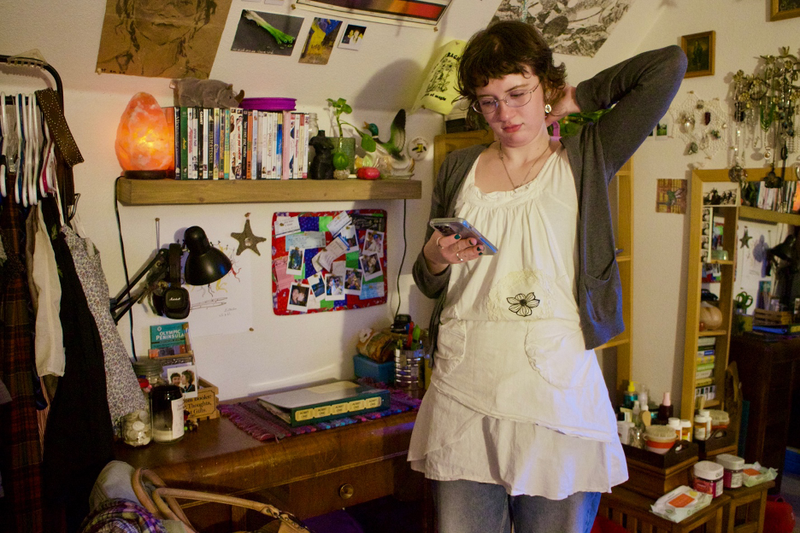
Molly stands in front of the desk in her room, looking at her phone. Behind her are many posters and other things hanging on the wall, including photos of her and her partner, Rubin, and a shelf full of things she has collected.
There’s another factor that plays into how I create my sense of home now as well; not only do I share this house temporarily with my 4 roommates (and 3 cats), but I share this room (and every foreseeable room) indefinitely with my partner, Rubin.
Because I share this space with my partner, it is, in essence, my home. After four years, I see them as an integral part of my sense of home. I would not have one if they were not in it. Rubin’s home and how they create it has been entangled with my home and how I create it, but it’s beyond that.
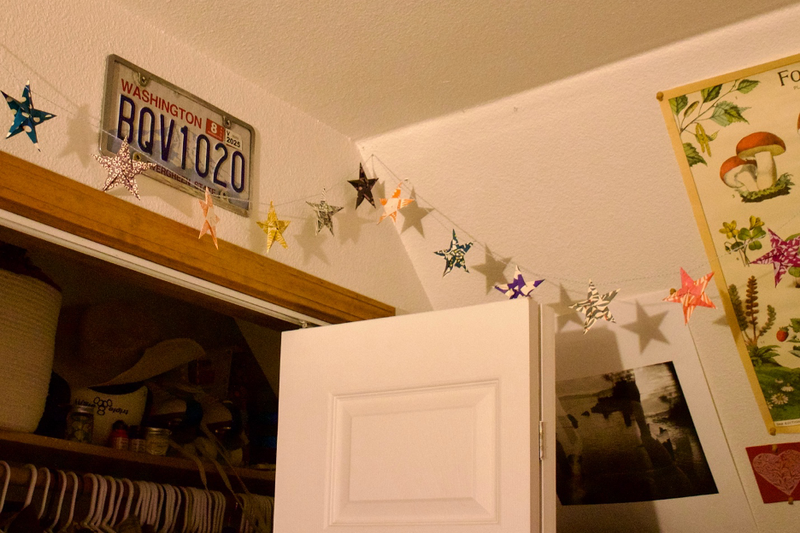
A garland of paper stars that Molly made hangs in the corner of her room, above her closet. On the wall behind the garland is a patchwork of posters and things that hold sentimental meaning to her, including the license plate from her first car, which is attached to the wall above her closet door.
Who I am now is everything that I have experienced up to this point, and my sense of home is rooted wholly in myself—it’s how I was able to create a sense of home when the space itself was split and everchanging in my adolescence. Every square inch of our room, the space that is solely mine and Rubin’s to create our home, is a reflection of myself, but also of Rubin. In that sense, Rubin is a part of me, and to make it my own home is to also make it their own home, too.
Our walls are covered in photos of the two of us, from the first year we were together to just this last, between posters for music we’ve bonded over and ephemeral bits of memories we made together.
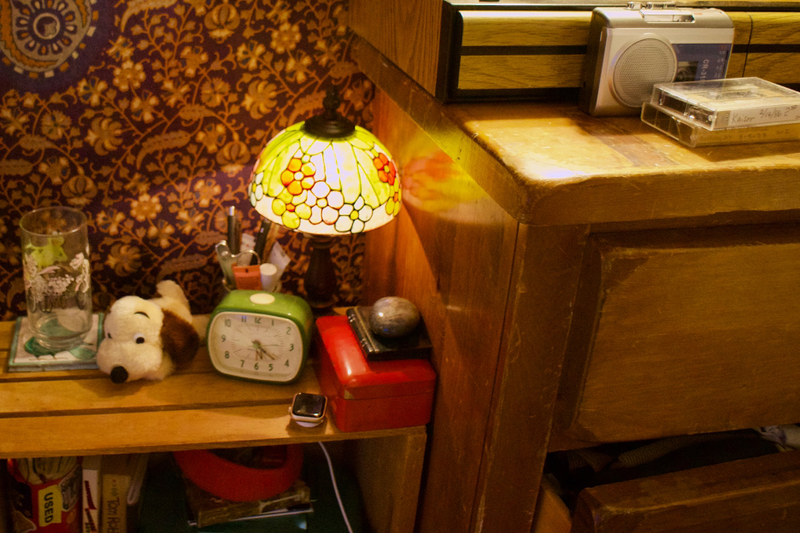
A close-up of the crate that Molly uses as a nightstand and the corner of their dresser. On top of the dresser is a portable tape player, two of her partner’s live Grateful Dead tapes, and a storage container for the tapes. On top of the nightstand is a vintage tiffany lamp that used to be her great grandmothers, an alarm clock, a vintage stuffed dog that she got from her roommates for her birthday, and a vintage The Great Muppet Caper glass that she got for Christmas.
Creating my sense of home is rooted in contemplation, creation, connection, collection, and composition. Some of my earliest concepts of what home felt like were lying underneath a quilt my Grammy had sewn herself, listening to my dad mindlessly strum his guitar on the couch while we watched TV, hearing the stories my Oma had for each heirloom piece of furniture she had collected over the years, or sitting on my mom’s lap, reading books and asking her what certain words meant.
Thus, my home is (and always will be) filled with music, heirlooms and gifts, handmade things and the tools to create them, and books, so many books.
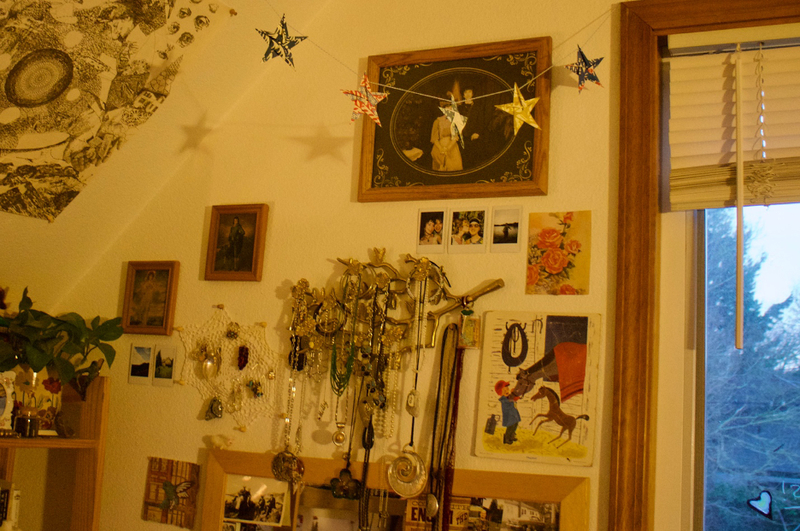
A close-up of the wall next to Molly’s window, where she has hung her jewelry organizers, filled with jewelry and many photos, including a large portrait of her and her partner, Rubin, dressed in Victorian-era garb.
Now, home means knitting and sewing to feel close to my grandmas, who taught me those skills, and so my home is filled with the fruits of those labors. Now, home means having things that are more than their physical worth—it’s the sentimental worth and the stories that the objects are tied to that connect me to the people who created that sense of home for me in the past and supported me to this current iteration of home, like the lamp that used to be my great-grandmother’s or the keepsake box my grandpa made specially for me when I was a child. Now, home means books, everywhere—shelves packed so full that the books are stacked in front of other books. Now, home means music, in all its forms, always playing, or at least lingering, in posters on the wall, instruments leaning against the side of the bed, or the countless physical forms of music collected.
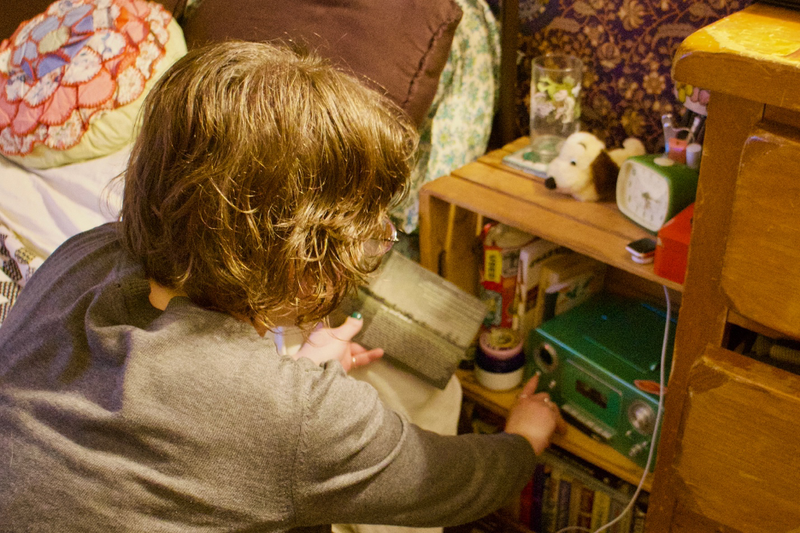
Molly stoops in front of the stereo in her nightstand to play Gregory Alan Isakov’s Evening Machines on CD.
For Rubin, their sense of home growing up was a lot like my own, and so, coming together to form our home felt something like it was meant to be—as I type this, I am sitting at the worn-down desk Rubin bought first thing after he moved to Bellingham, and when I take out my sewing machine, which my Grammy gave me, to mend a pair of his pants, I will set it on this same desk. My sense of home is stacked on his sense of home is stacked on my sense of home.
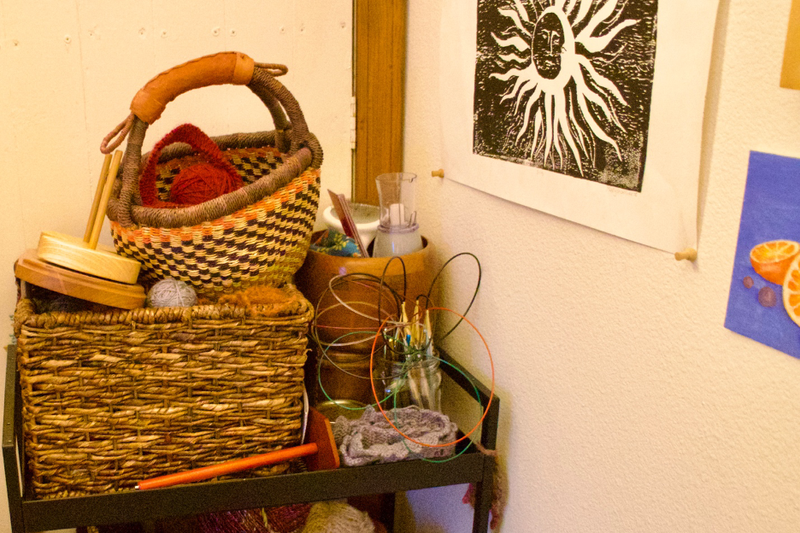
A close-up of Molly’s yarn cart sitting in the corner of her room, the top piled with baskets and other containers filled with yarn, knitting needles, and other notions. On the wall next to the cart hangs a linocut that she made in high school and a still life of oranges and grapes that her former roommate painted.
When we moved in together, we compiled our individual collections of CDs and books into one, and now they’re our collection of CDs, and our collection of books. After a while, Rubin got rid of the bed he had bought, which we shared, and we bought a bed together. That bed is honestly a piece of crap, but it’s our bed.
The more and more that Rubin and I’s space becomes our space, the more and more that sense of home is created for us. I still have my things, as does Rubin, which is just as necessary, as we are still individuals, but I wouldn’t feel at home in this space if Rubin wasn’t included in it, just as much as I wouldn’t feel at home in this space if I wasn’t included in it.
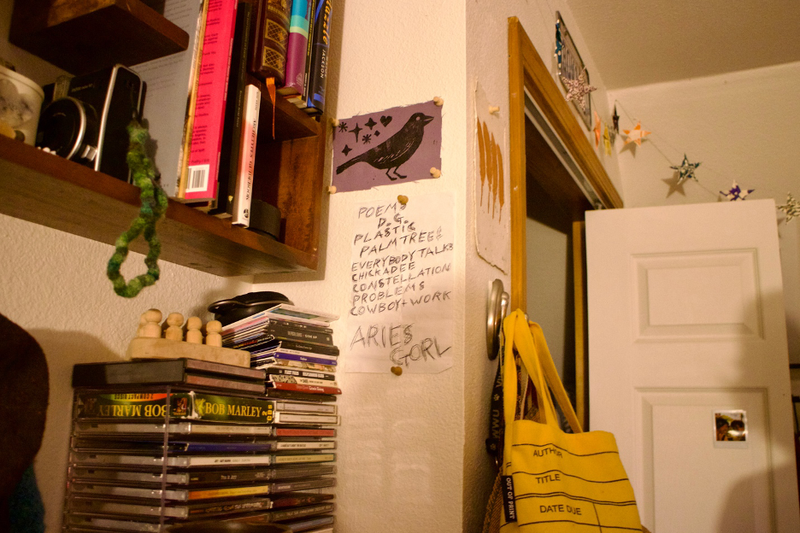
The setlist for a show that Molly’s partner, Rubin, played with their band Frog Rocket last year hangs on the wall next to a shelf filled with poetry books. Underneath the shelf is a CD organizer filled with CDs that Molly and her partner, Rubin, have collected over time.
To me, home is something that is always becoming, as I am always becoming. The only constant is change, in myself, my life, and every facet of that, so of course my home reflects that. Still, my home is me, and every facet of that. Rubin being my counterpart, of course they are a significant part of my home, but so is everything else that has been, is now, and will be a part of me.
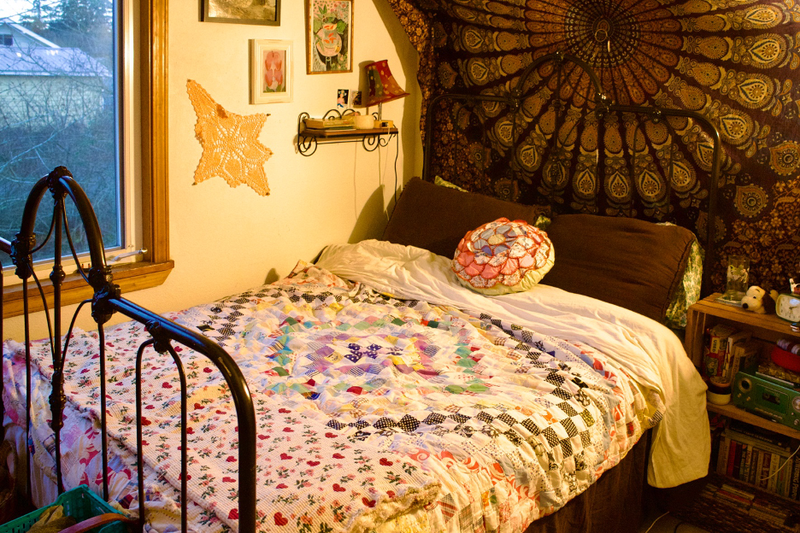
Molly’s bed, which sits in the corner of her room, is made up with a vintage postage stamp quilt, a floral blanket that her roommate gave her, and a vintage patchwork floral pillow. Behind the bed hangs a tapestry that her partner, Rubin, has had since before they got together.
My home is what reminds me of who I am, my home is essentially me, as that is the most constant, guaranteed source of home, or at least the feeling of it. A patchwork of everything I have touched or been touched by, interwoven into this space.
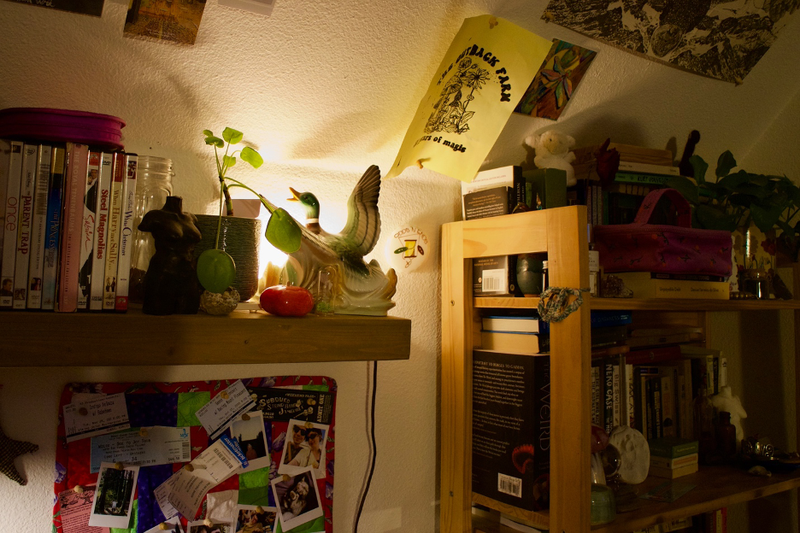
The shelf that hangs above Molly’s desk, which holds her DVD collection, a plant, a vintage duck lamp that she received from her grandma, and an assortment of other trinkets. Next to the shelf stands a bookcase, overflowing with books and scattered with other treasures.
For each of us, Brent, Lily, and I, our homes look a lot different. But, our senses of home, how we create that, is inextricably rooted in ourselves, our lives, our loves, and our connection to something beyond that, to stories, sentimentality, and maybe spoons too.
As Brent would say, Zamboni.
